Vija Skangale, Guram Tsibakhashvili, Elene Abashidze, Giorgi Gago Gagoshidze
17.10, 14:00–17:00
Fylkingen
Sveavägen 41
Stockholm
Symposiet fokuserar på experimentella konstpraktiker i Georgien under de turbulenta åren kring Sovjetunionens kollaps.
Konsthistorikern och curatorn Vija Skangale presenterar sin pågående forskning om performancepraktiker under 1980- och 1990-talen. Med utgångspunkt i arkivmaterial och dokumentation av konstnärliga verk undersöker hon hur konstnärer navigerade sociala och politiska kriser, från Sovjetunionens upplösning till det georgiska inbördeskriget (1991–1993).
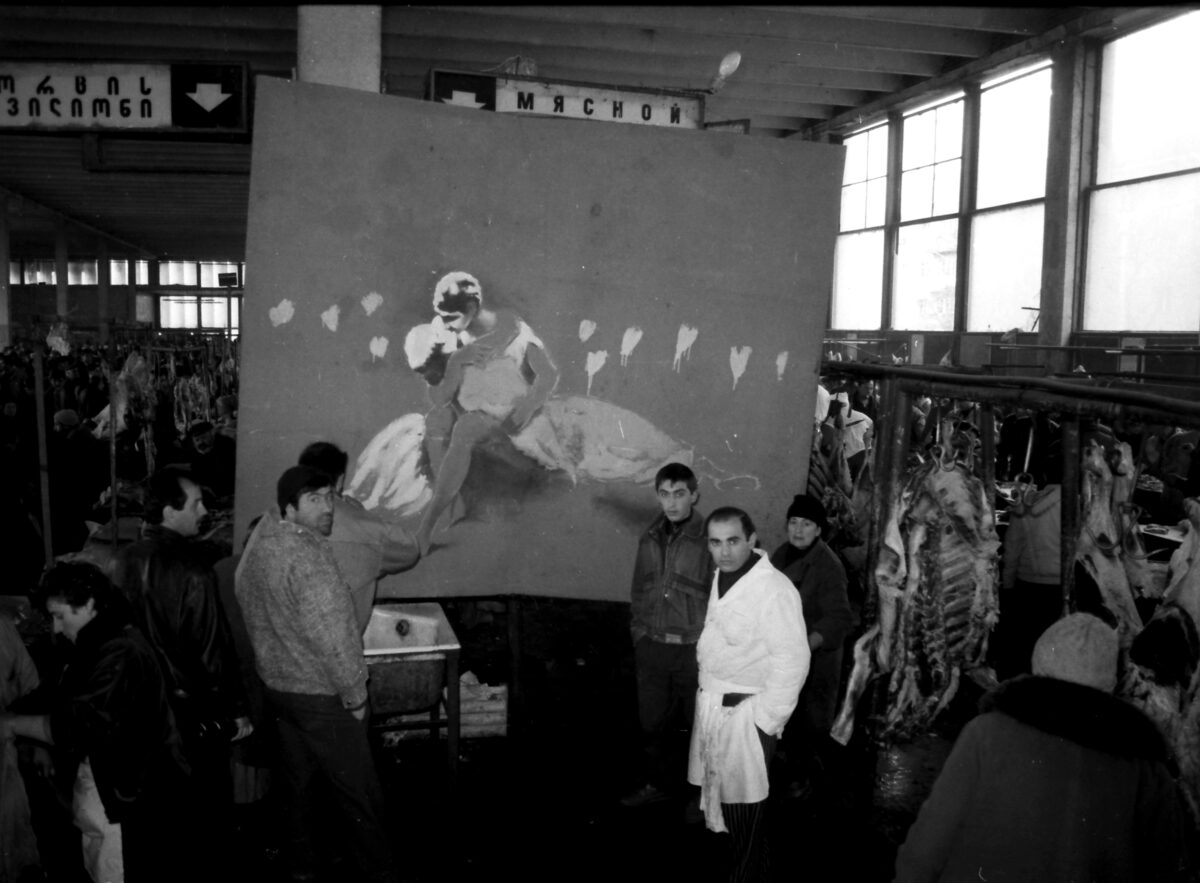
Fotografen Guram Tsibakhashvili presenterar sitt fotografiska arkiv, som dokumenterar det konstnärliga livet i Georgien under perioden. Därefter visas konstnären Giorgi Gago Gagoshidzes film Graft Versus Host (2026), en spekulativ dokumentäressä som knyter samman filmskaparens egen medicinska historia med de geopolitiska omvälvningarna efter kalla kriget och deras konsekvenser för dagens politik.
Curatorn Elene Abashidze avslutar symposiet med en sammanfattande reflektion.
Samma dag öppnar Mint en utställning med verk av Guram Tsibakhashvili på våning 6 i ABF-huset, curaterad av Elene Abashidze. Mer info.
Med stöd från Helge Ax:son Johnsons stiftelse, Längmanska kulturfonden och IASPIS
Vija Skangale
Vija Skangale is a writer, curator, and researcher from Georgia currently based between Tbilisi and London. She is a PhD candidate and a visiting lecturer at Central Saint Martins, University of the Arts London. Vija has participated in various art projects, including those at Kunsthalle Tbilisi, Tate Modern Late, and Tate Exchange, among many others. Her practice lies between research and curated exhibitions & performances (including performance re-enactments). Vija’s written work has been published in outlets such as MoMA, S.M.A.K. Museum, Afterall, Biennial Foundation magazine, the Calvert Journal, and the Tbilisi Public Art Fund, among many others. The upcoming publications include a contribution to a book by Routledge and the University of Basel. Her research focuses on the exhibition histories within the context of post-socialist transitions. She examines under-documented performance practices and exhibition histories in Georgia, aiming to broaden our understanding of performance-making during significant cultural and political transformation. In 2025, she founded the Institute for Contemporary Art Research in Georgia.
Guram Tsibakhashvili
Born in 1960 in Tbilisi, Georgia, Guram Tsibakhashvili is a prolific contemporary photographer known for his powerful visual documentation of Georgia’s social, political, and artistic life – especially during the tumultuous decades following the collapse of the Soviet Union.
Starting his professional journey after graduating from Tbilisi State University in 1982, Tsibakhashvili first worked in chemistry, but soon turned his focus to photography. By the late 1980s, he was photographing the streets of Tbilisi and experimenting with fine art and documentary photography.
Tsibakhashvili’s work captures historic turning points in Georgia – protests, conflict, daily life, cultural revival, and artistic expression in difficult times.He has also played a key role in building Georgia’s photographic and cultural infrastructure. Today, Guram Tsibakhashvili is recognized not only as a witness of Georgian history, but also as a teacher, curator, editor, and mentor shaping the next generation of Georgian photographers.
Giorgi Gago Gagoshidze
Born in Kutaisi, Georgia in 1983, the artist and filmmaker is now based in Berlin. He studied at the State Academy of Fine Arts in Tbilisi and then took a degree in new media at the Berlin University of the Arts. His works focus on the moving image, the political background of its production and distribution, and its socio-political significance. They have been presented in numerous international contexts including at the Taipei Biennial in 2023, the National Art Center in Tokyo and the SculptureCenter in New York.
Filmography 2016 Its Just a Single Swing of a Shovel; documentary 2018 The invisible hand of my father; documentary 2019 Mission Accomplished: Belanciege 2022 Stone of Hell; documentary 2026 Graft Versus Host; documentary
Elene Abashidze
Elene Abashidze (b.1987, Tbilisi) is a curator and writer living and working in Tbilisi,Georgia. Abashidze’s curatorial practice spans exhibition-making, publishing and writing. In 2019 Abashidze founded E.A. Shared Space – a project space aiming at creating a cross-cultural and cross-generational dialogue between local and international art scenes. Led by the local historical, cultural and socio-political context, the program supports feminist and queer art practices deeply engaging with the local audience. Exhibition driven the programme comprises artist talks, poetry readings, screenings, presentations and publishing practices.
Between 2024 – 2016, Abashidze was a founding co-editor for a non-profit bilingual series of publications Danarti. Focusing on historical and contemporary art, architecture, poetry and critical thought, the magazine existed both online and in print. The project has been generously supported by Kunsthalle Zürich.
Abashidze received MFA in Curating Contemporary art at Goldsmiths College, University of London and BA in Art History and Theory at Tbilisi State University.
Image: Analog photo from 1994 by Guram Tsibakhashvili